Alt Text:
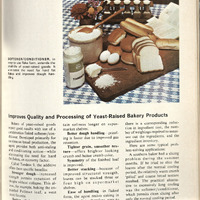
A Food Engineering “ingredient news” page shows a bakery ingredient called Tandem 9. On the picture of the table it was put with bread, little buns, eggs, flour and a jar with the label “TANDEM”. The table cloth was covered in blue and white color. The article explained that this type of softener can improve the texture of the dole, making the production more cost effective and enhancing the quality of yeast’s function in the dole.
Text Transcription:
ingredient news
SOFTENER/CONDITIONER, in easy-to-use flake form, extends the shelf-life of yeast-raised goods. It eliminates the need for hard fat flakes and improves dough handling.
TANDEM
Improves Quality and Processing of Yeast-Raised Bakery Products
Bakers of yeast-raised goods report good results with use of a combination flaked softener/conditioner. Developed primarily for continuous bread production, the agent provides both anti-staling and conditioning action—while eliminating the need for hard fat flakes, an economy factor.
Called Tandem 9, the additive offers these specific benefits:
Stronger dough—increased strength permits expansion of doughs without collapse. This allows, for example, baking the expanded Pullman loaf, a west coast favorite.
Better slicing—structural strength provided by the agent minimizes shredding and tearing of the loaf during slicing, particularly noticeable in warm weather.
Improved softness—loaves retain softness longer on supermarket shelves.
Better dough handling—proofing is faster due to improved gas retention.
Tighter grain, smoother texture—offers brighter looking crumb and better crumb color.
Symmetry of the finished loaf is improved.
Better stacking—because of improved structural strength, loaves can be stacked three or four high on supermarket shelves.
Ease of handling—in flaked form, the agent resists caking in the drum. It is, therefore, easy to handle, scoop and weigh.
Production savings—this softener/conditioner replaces three ingredients: a conditioner, a softener, and hard fat flakes. Thus there is a corresponding reduction in ingredient cost, the number of weighings required to measure out the ingredients, and the ingredient inventory.
Here are some typical problem-solving applications:
A southern baker had a slicing problem during the summer months. If he tried to slice the loaves after the normal cooling period, the relatively warm crumb ‘pilled’ and coarse bread texture resulted. The practical alternative to excessively long cooling was the softener/conditioner, which permits clean slicing after only the normal cooling period.
A midwestern baker ships loaves and hamburger rolls over long distances. Extra shelf life became a necessity. Using the conditioner/softener provided the
FOOD ENGINEERING, October 1972
39
Observation:
This advertisement is making Tandem 9 as a baking softener to promote industrial bread production. The core advantages included a softer texture for the bread, easier to have slices and preserve for a longer time with lowering the cost of production. Making the ingredient looked relevant to daily baking activities, even though the focus was on industrial production. The text also demonstrated how additives can be used to solve actual factory problems especially on lowering the cost of production.
Tom Liu