[alt text]
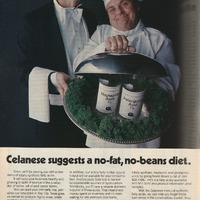
Two men are holding a silver platter, one man is holding the bottom half of the platter and is a server wearing a white bow tie and black suit and carrying a napkin on his forearm looking smug/impressed and the chef on the right side is wearing an all white chef uniform and is also looking content holding the top half of the platter
The platter contains two bottles, the bottle on the left is Heptanoic Acid C7 and the bottle on the right is Pelargonic Acid C9, both bottles are surrounded by green leaves
[transcription]
#Celanese suggest a no-fat, no beans diet.
Soon, we’ll be serving you with a new menu of totally synthetic fatty acids.
It will keep your business healthy and growing in spite of slumps in the production of tallow, tail oil, an castor beans.
You can start your diet early this yeat when our new plant in Bay City, Texas goes on stream to produce highly linear, totally synethtic heptanoic and perlagonic acids.
In addition, our entire forty-million-pound output will be available for your consumption. And because Celanese is backed by dependable sources of hydrocarbon feedstocks, you’ll have a reliable domestic supplier of these acids. That means less money spent on inventory and no more waiting for late overseas shipments.
Find out more about our new diets of totally synthetic heptanoic and pelargonic acids by giving Norm Baker a call at 201-522-7738. He’s our fatty acids specialist and he’ll send you product information and samples.
With the Celanese menu of synthetic fatty acids. we can help you forget those lean times in the commodities market. And that’s not hard to swallow.
##CELANESE CHEMICAL COMPANY, INC.
###Celanese… there’s no subtitute for commitement.
[additional notes]
What is Celanese?
‘a company that is the leading producer of acetic acid, the word Celanese is a combination of cellulose and ease: promoting the ease of cleaning and care for their acetate’
the play on the metaphor of serving demonstrates the companies commitement to ‘catering’ to the consumer
the company understands the complexity of the production process and gives a solution to such challenges
having the two men approve of the acids makes the viewer more inclined to purchase this product
diet: there are many repetitive words about dieting, from the ‘no-fat’ description to the word ‘diet’ itself, when a viewer sees the word ‘no’ they are more likely to presume that they are consuming something healthy but that health is defined by a chemical that is processed
a chemical that guarantees large ouputs is good for making a company’s money’s worth investing
the supply itself is based on guaranteed soruces: trying to prove there are no faults in the Celanese
shipments is not a common factor to include in ads therefore I find it interesting that it is used here, in this case the ad seeks to explain that the company also doesn’t have to wait as long to receive what they purchased
money is no longer tied to ensuring products come on time
the green leaves aid in this idea of ‘healthy’ as it surrounds the chemicals, it can also be alluding to the fact that these chemicals are inhibiting bacteria and allowing healthy growth to occur for food (no molding)
the inclusion of a ‘specialist’ further emphasizes their message of being very knoweledgable in their creation of Celanese
a lot of the rhetoric here is using dietary commenatry such as ‘lean’ and ‘fatty’, there seems to be a turn towards healthier alternatives
the word ‘menu’ guarantees a selection like a menu a server would give to a customer: multiple options (variance)
the advertsiement akcnolwedges that the food market is not always stable, there are low points and high points in sales and products avialable, however they state that they can combat such periods due to such a high selection of Celanese
understanding the scarcity of production
artificial materials are better than natural materials as it is easier to handle and massively produce
avoiding the problem of running a company dry
persuasive when pointing out problems that are extremely inherent in the food business, where multiple companies are buying from the same seller
no more reliance on short-term materials
What is tallow?
‘whiteish substance that is solid at room temperature, made by removing the fatty tissue that surround the organs of animals, commonly made from cow’
‘used for cooking at high temperature such as deep frying and roasting but also for nonfood uses such as soaps and skincare’
‘contains saturated far and non-saturated fat’
comparing raw materials such as tallow and castor beans against this chemical proves its necessity against the insatbility of materials that can run out
supplies can sometimes not meet the demands but chemicals can
What are castor beans made out of?
What is synthetic heptanoic and pelargonic acid used for?
both are fatty acids, synthetic heptanoic acid is ‘colorless, oily, with a strong and fruity odor’
mainly used to manufacture ‘fragrances, synthetic lubricants’
more stable
within foods it is a ‘preservative and flavoring agent, extends shelf-life by inhibiting bacterial growth’
marketing a chemical that is able to provide control during the lengthy production process
pelargonic acid: ‘naturally occurring biodegradable nine carbonfatty acid found in animals and plants, used in synthetic lubricants, flavorings, and anti-microbial’
this ad advertises both these chemicals in the sense that they can extend ‘naturalness’
within food it is used for its ‘distinct odor and taste to contribute to the sensory characteristics of certain food products’
combination of sensory and visual appeal for the food, extremely ideal for companies needing a chemical to have such diverse uses
Themes: dietary food, time efficient, selections, risk factors, commodification, reliability, stability, duality, diversity, inhibition, visual appearance
[Karlene Rodriguez]