[Alt text] Close up shots of water moving. Images of metal pipes foaming, a white male scientist studying a liquid product, and zoomed-in, standardized, white eggs.
Transcription: Foam… Wyandotte surfactants may hold the key to your foam control problem
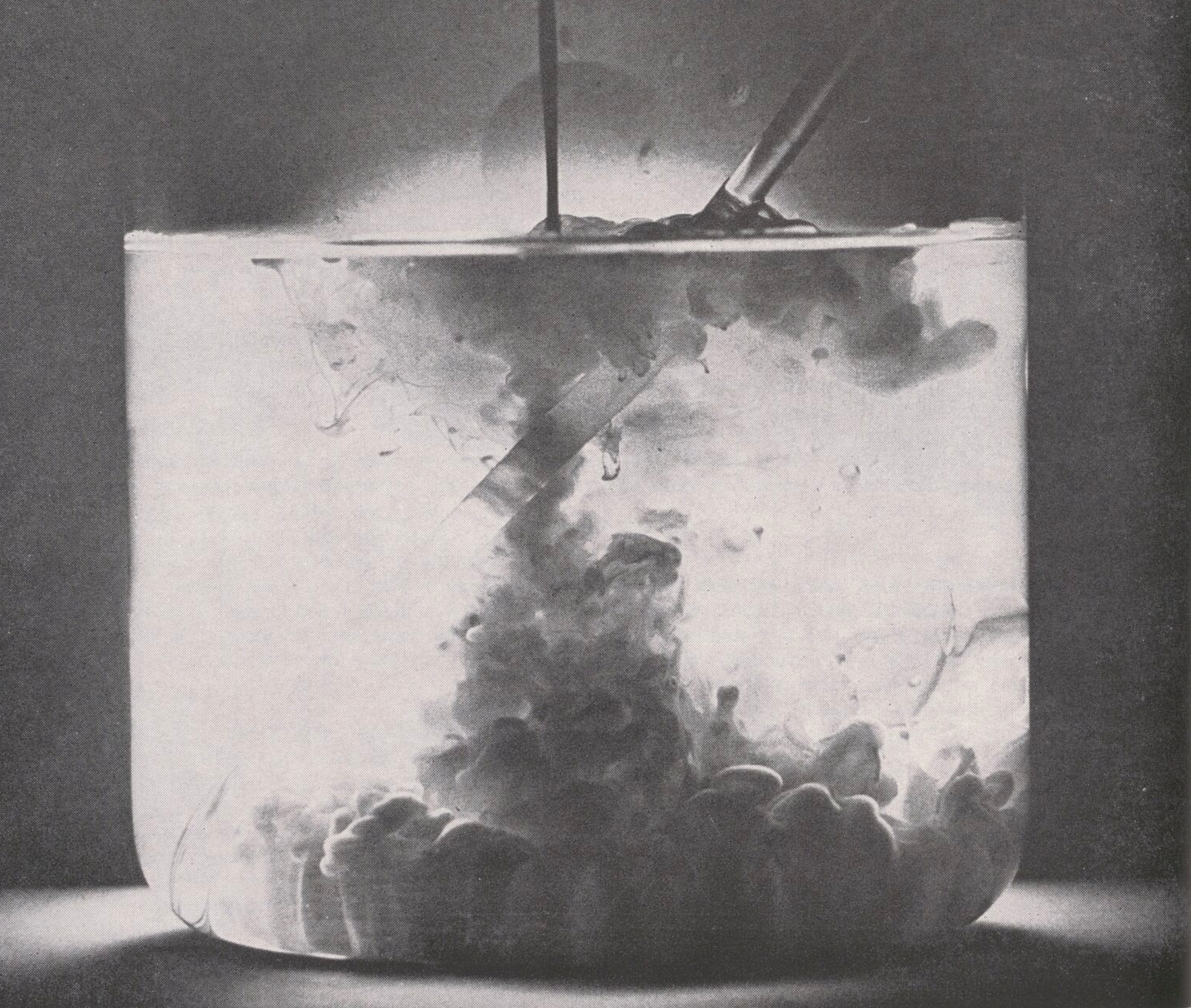
Foam… in a cushion it means comfort; in metal cleaning, it spells trouble. In ore flotation, it’s desirable; in the paper industry, it’s a disaster. Foam can waste space, material and labor; rob a plant of its profit. Foams are of many different types: some stable, some self-healing; some foams collapse immediately. A familiar phenomenon… Yet the physics of foam are so intricate and complex that many “how” and “why” questions remain unanswered. Nonetheless, the success of many processes depends upon effective foam control. Since surfactants affect foam stability, Wyandotte examined its extensive line of nonionic polyols in relation to many foam problems… in such areas as anti-freeze and glues, food processing and breweries. And our Pluronic, Tetronic, Plurafac and Pluradot surfactants have proven to be useful keys. All 75 surfactants perform well in hard or soft water. They won’t leave detrimental residues, impart odors, color or taste. Most exhibit a low order of toxicity. Many inhibit foam… some stabilize it. Chosen grades excel in specific applications. Thus, in spray cleaning of metal parts, where foam must be avoided, certain grades of tetronic, Pluradot or Plurafac are recommended to maximize drainage, minimize foam… avoid films or spots on surfaces to be plated. In electro-cleaning, however, a controlled foam blanket obtained with certain Pluronic grades allows hydrogen gas to escape, retards evaporation of solution and reduces the heat required to maintain an optimum temperature. It has been industry’s practice to approach foam problems by the trail-and-error method. With the aim of bringing this art a little closer to a science, our report Wyandotte Surfactants in Foam Control tells how to determine a solution’s foam characteristics… how to choose the surfactant most likely to suit your needs. If foam is your problem… whether in product, process or maintenance.. you should have a copy of this report. Write for it. It's designed to suggest answers. Wyandotte Chemicals Corporation, Industrial Chemicals Groups, Department 661, Wyandotte, Michigan 48192.
a blessing or a bane?
IDEAS IN ACTION: Many industries benefit from Wyandotte surfactants
Would a Wyandotte surfactant improve your product or process? We, of course, can’t guarantee that it will. But many customers will tell you that our key chemical approach helped improve their products… and profits; that the service and use-information Wyandotte furnishes was beyond their expectancy. Take Wyandotte’s 75 specialized surfactants, for example. Most everyone associates these products with detergency. But the detergent industry is by no means the only benefactor from these key chemicals. Their surface active properties are utilized in drilling muds and textiles, pharmaceuticals and paint, dyes, insecticides and papermakers have found them useful. These surfactants function as emulsifiers, wetting and cleansing agents; they bind, stabilize, solubilize, disperse, dedust and control viscosity. Many effectively control foam. We have accumulated a cast fund of knowledge on their diverse applications. Chances are some of this information pertains to your problem. Why not write us and see?
Whether starch solutions are added to the pulp furnish for internal sizing or applied on a press for surface sizing, agitation of hot solutions causes foaming problems. Mill experience shows that 2 pounds of Pluronic L61 per ton of dry starch can effectively control this foam. Other successful applications of Wyandotte surfactants in pulp and paper include improved brightness of bleached kraft pulp, black liquor defoaming and use as a coating lubricant to improve surface properties, reduce costs.
Glycol-based antifreeze and year-round coolants perform better with the help of Wyandotte surfactants. Pluronic L61 and L101 not only control foam caused by corrosion inhibitors and other radiator chemicals, but provide permanent antifoaming protection against degradation products formed within the cooling system… help assure antifreeze manufacturers of a good product reputation in the marketplace.
In machine egg washing, protein soils cause excessive, troublesome foam… as little as 5% Plurafac RA-43 in the formulation gives effective control. Added benefits include a “squeaky clean” feel and good eye appeal. The Pluronic series’ low order of toxicity recommends their evaluation as foam control agents in such food processing operations as poultry cleaning, hog scalding, washing and peeling of vegetables and fruits. Additional information is available upon request.
Comments: These surfactants, which extend beyond food processing into numerous other applications, are designed to control and inhibit foam. By doing so, they help preserve the appearance, texture, and structure of food products over time. This reflects the food industry’s emphasis on standardized products with long shelf lives that maintain a fresh and appealing look. The two-page advertisement’s extensive text describes Wyandotte’s trial-and-error process of creating and refining its surfactants. By emphasizing this experimentation, the company conveys that its scientists invest significant time, energy, and resources into producing high-quality products, reinforcing the image of reliability, precision, and attention to detail.
Leila Dubon